The right historical crypto data provider is the one that covers your exact instrument and period, preserves the fields needed for valid replay, fits the delivery stack, and grants the required usage rights. Company-wide exchange counts and row totals do not answer those questions.
Disclosure: we built CryptoHFTData. This comparison uses first-party product documentation, separates published features from our assessment, and names the cases where another provider has the clearer fit. The product research was reviewed on August 10, 2026. Pricing, entitlements, and coverage can change; confirm the final scope with each provider. We did not run a controlled completeness or performance benchmark across all five products; the common sample protocol below is the decision step.
For a short vendor-by-vendor view, open the /vs comparison hub. The research method and source notes are below.
Shortlist by research need
| Provider | Put it on the shortlist for | Confirm before committing |
|---|---|---|
| CryptoHFTData | Recent normalized trades, L2 events, liquidations, open interest, and funding on covered venues; hourly Parquet/Zstd files | Required history starts in 2025 or later and the venue set is selective |
| Tardis.dev | Deeper tick history, exchange-native messages, normalized files, and historical replay | History and API entitlement for each selected plan |
| Kaiko | Broad institutional coverage, derived products, managed delivery, and enterprise support | Granularity, history, and delivery included in the quoted package |
| CoinAPI | A large integration catalog and several live, API, and flat-file interfaces | Usage-based cost and the schema for each required product |
| Amberdata | Exchange market data alongside blockchain, DeFi, wallet, pricing, or derivatives analytics | Whether the broader platform is useful for the actual workflow |
These categories overlap. Treat them as entry points for sample testing rather than a ranking.
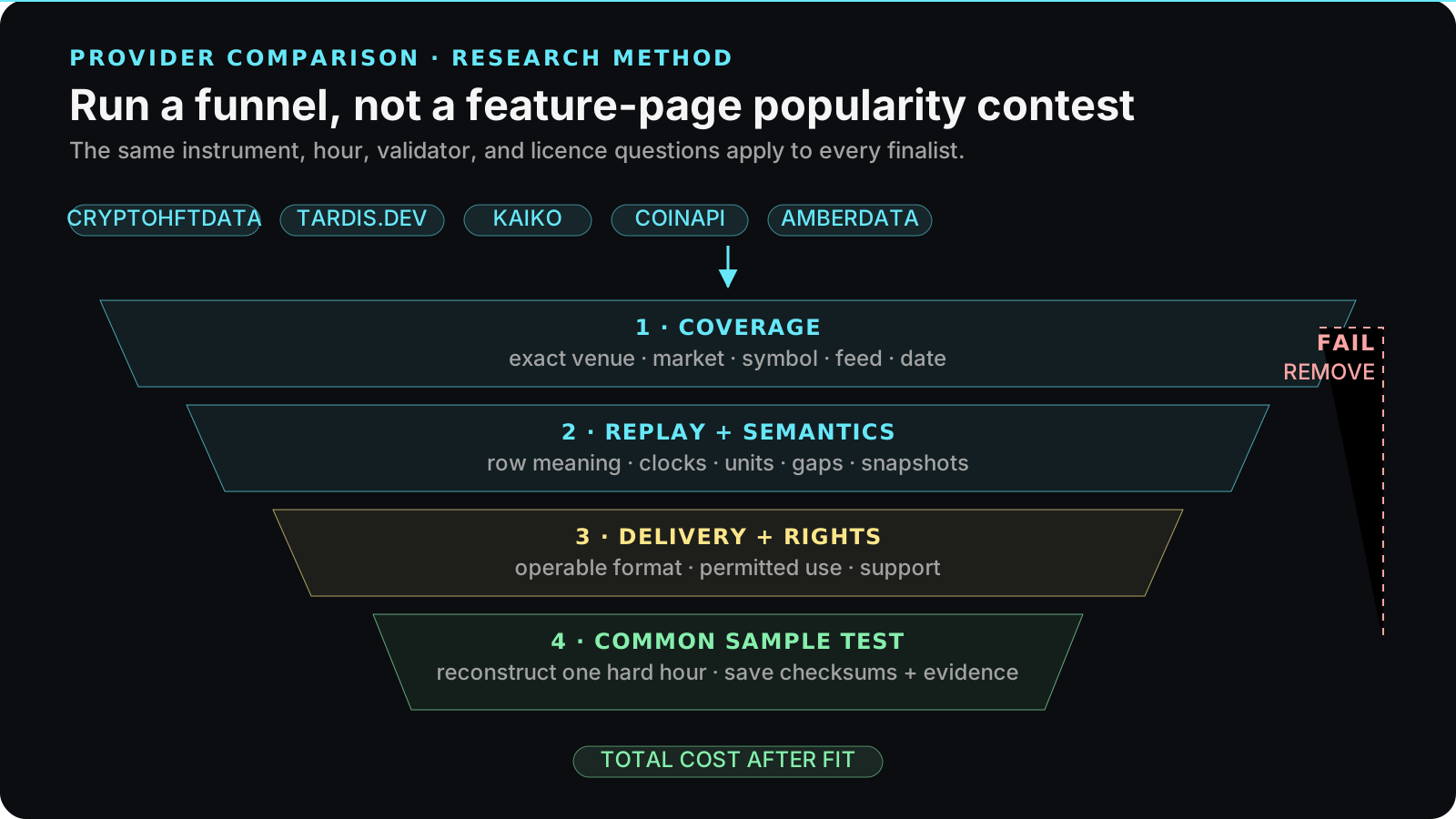
Hard requirements remove unsuitable products early. Only technically valid samples reach the cost comparison. Source: CryptoHFTData provider-evaluation method, August 2026.
Freeze the requirement before reading feature pages
Write a one-page data contract:
| Dimension | Questions that decide fit |
|---|---|
| Instrument | Which venue, spot or derivatives market, symbol, and contract type? |
| Event | Trades, L2 updates, full snapshots, liquidations, open interest, funding, mark price, or top of book? |
| Time | Earliest required date; continuous updates after the backfill? |
| Replay | Exchange-native messages or a documented normalized event schema? |
| Clocks | Exchange time, collector receive time, sequence identifiers, or all three? |
| Delivery | Bulk files, range API, local replay, live WebSocket, cloud warehouse? |
| Rights | Internal research, client output, model training, derived products, or raw redistribution? |
A missing sequence field can invalidate an execution simulator regardless of price. An enterprise platform may be excessive for a study that needs one year of trades from a single perpetual market.
CryptoHFTData's current scope
CryptoHFTData covers nine exchange brands: Binance, Bybit, OKX, Bitget, Kraken, Hyperliquid, Aster, BitMEX, and Lighter. Spot and derivatives coverage differs by venue. The dataset catalog and exchange directory are the source of truth for markets, data families, history dates, schemas, and samples.
The archive contains normalized L2 price-level snapshots and updates, tick-level public trades, and venue-published derivatives observations where supported. Files are partitioned by exchange, date, hour, symbol, and data type in Parquet/Zstd format, with Python SDK, REST, and S3-compatible access. See the order book dataset, trade dataset, and SDK documentation for concrete examples.
Five boundaries should be explicit:
- The earliest integrations start in 2025; newer venues begin later.
- The exchange catalog is selective rather than long-tail.
- Normalized columns do not erase venue-specific multipliers, quantity units, liquidation sampling, or sequence semantics.
- The product archives exchange market feeds and has no wallet or blockchain analytics.
- Current access is zero-cost. The standard licence terms cover personal and internal company use; redistribution and downstream data products require a separate licence.
Those constraints make CryptoHFTData a focused candidate for recent research on covered markets. Projects that fall outside them should use another source.
How the alternatives differ
Tardis.dev: native messages and deeper replay history
Tardis.dev's documentation describes more than 50 spot and derivatives integrations, exchange-native HTTP replay, normalized tick-level CSV datasets, official client libraries, and a local replay service. Its coverage pages show many established feeds beginning in 2019.
That product shape suits pre-2025 tests, native-message fidelity, options, and teams that want dedicated replay infrastructure. CryptoHFTData offers a simpler recent-history Parquet workflow when its venues and start dates meet the research contract.
Read the focused Tardis.dev comparison, then verify current details in the Tardis.dev documentation and billing documentation.
Kaiko: broad institutional data and managed delivery
Kaiko's public materials describe more than 100 centralized and decentralized exchanges, normalized L1 and L2 data, tick-level and aggregated delivery, liquidations, cloud storage, streaming, and data-warehouse options. Its product portfolio also covers institutional workflows beyond research-file downloads.
Consider Kaiko for older history, broad market or reference coverage, managed delivery, and contractual support. Scope the exact product tier because granularity, history, and interfaces differ.
Read the focused Kaiko comparison and check Kaiko's L1 and L2 product page and developer documentation.
CoinAPI: integration breadth and interface choice
CoinAPI's product pages advertise hundreds of exchange integrations and access through REST, WebSocket, FIX, S3 flat files, Snowflake, and other interfaces. Its historical flat-file catalog includes tick trades, quotes, snapshots, and full limit-order-book files.
That breadth is relevant for long-tail venues, a unified live feed, FIX, or an existing CoinAPI interface. Estimate credits and product-specific costs against the actual symbol list and query pattern.
Read the focused CoinAPI comparison, the Market Data API overview, and its flat-files documentation.
Amberdata: market and on-chain evidence in one platform
Amberdata combines exchange market data with blockchain, wallet, DeFi, pricing, liquidity, and derivatives analytics. Public materials list REST, WebSocket, AWS S3, and cloud-platform delivery.
Its broader evidence set is relevant when exchange events must be joined with on-chain activity or managed institutional analytics. A file-only market-data study may use little of that scope.
Read the focused Amberdata comparison and verify the current catalog on Amberdata's market data and platform pages.
Test every finalist on the same slice
Choose the exact venue and market type, an active symbol, and a busy hour. Ask each provider for the same feeds and evaluate them with one script.
- Confirm symbol, market class, data type, and first available date.
- Define what one trade or book row represents.
- Identify exchange time, receive time, sequence fields, and tie-break rules.
- Reconstruct L2 state from a valid snapshot; check connected updates, deletions, and crossed-book conditions.
- Count gaps, duplicates, reconnects, empty files, and schema changes.
- Save source objects, checksums, code revision, and validator output.
Use the download workspace for a CryptoHFTData sample and the /datasets catalog to verify event semantics, coverage, history, sample files, and caveats before running the acceptance protocol.
Compare rights and total cost last
Request a quote or model usage for the same instrument set and workflow. Add transfer, decompression, parsing, storage, normalization, monitoring, support, and missing-history costs to the access price.
Review usage rights independently. Internal backtesting, company-wide storage, client reporting, derived redistribution, model training, and raw-data redistribution may have different permissions. The governing terms or contract should answer each intended use.
Eliminate any provider that fails coverage, replay, delivery, or rights. Run the common sample test on the remainder. The lowest total cost is meaningful only after the resulting dataset is valid for the stated research decision.
First-party sources
- Tardis.dev product overview and historical data details
- Kaiko L1 and L2 market data
- CoinAPI historical flat files
- Amberdata market data
- CryptoHFTData datasets and licence terms
If a published feature has changed, send the first-party source through support so the dated comparison can be corrected.